Modern Optical Engineering: The Design of Optical Systems, Fourth Edition

19.6: The Lenses

19.6 The Lenses

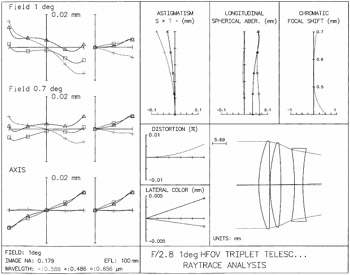
F/2.8 Airspaced Triplet Telescope Objective. At F/2.8, this lens is much too fast for a telescope objective, but it serves as an excellent example of how the higher order aberrations may be controlled. Splitting the crown element in two reduces the undercorrected zonal spherical aberration. The large airspace between the crowns and the flint controls the spherochromatism, and also reduces the zonal spherical. The result is a lens so well corrected for spherical and spherochromatism that (on axis) it is is effectively perfect, except for the very obvious secondary spectrum. This problem can be corrected by the use of glasses with unusual partial dispersions (at the expense of increased aberrations and/or the higher cost of a difficult-to-work glass).

The off-axis plots show the effects of the unsymmetrical format of the lens and the relatively wide separation of the positive crowns and the negative flints. Note the higher order coma, and especially the lateral and longitudinal chromatic aberrations in these plots. A symmetrical + - + construction rather than this + + - arrangement would reduce these problems.

This lens requires tight tolerances on the centering and mounting of the elements. A form which cements one crown to the flint [e.g., (+ -) +, + (+ -), or + (- +)] is much less sensitive to misalignment and is easier to fabricate.

F/2.8 1 HFOV Triplet Telescope Objective

radius

thickness

mat'l

index

V-no

sa

EFL

= 100

50.098

4.500

UNLIMITED FREE
ACCESS
TO THE WORLD'S BEST IDEAS

SUBMIT
Already a GlobalSpec user? Log in.

This is embarrasing...

An error occurred while processing the form. Please try again in a few minutes.

Customize Your GlobalSpec Experience

Category: Meniscus Lenses
Finish!
Privacy Policy

This is embarrasing...

An error occurred while processing the form. Please try again in a few minutes.