Power Distribution Networks with On-Chip Decoupling Capacitors
Decoupling capacitors are widely used to manage power supply noise. A decoupling capacitor acts as a reservoir of charge, which is released when the power supply voltage at a particular current load drops below some tolerable level. Alternatively, decoupling capacitors are an effective way to reduce the impedance of power delivery systems operating at high frequencies [27]. Since the inductance scales slowly [207], the location of the decoupling capacitors significantly affects the design of the P/G network in high performance ICs such as microprocessors. With increasing frequencies, a distributed hierarchical system of decoupling capacitors placed on-chip is needed to effectively manage power supply noise [334].
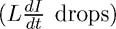
The efficacy of decoupling capacitors depends upon the impedance of the conductors connecting the capacitors to the current loads and power sources. During discharge, the current flowing from the decoupling capacitor to the current load results in resistive noise ( IR drops) and inductive noise (
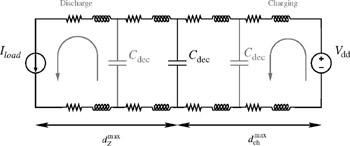
) due to the parasitic resistances and inductances of the power delivery network. The resulting voltage drop at the current load is therefore always greater than the voltage drop at the decoupling capacitor. Thus, a maximum parasitic impedance between the decoupling capacitor and the current load exists at which the decoupling capacitor is effective. Alternatively, to be effective, a decoupling capacitor should be placed close to a current load during discharge (within the maximum effective distance d max Z), as shown in Fig. 18.1.