Practical Energy Efficiency Optimization

Presenting basic information for optimizing power plants, this book uses review exercises and practical case studies to provide real-world applications on maintaining optimal efficiency.
 TABLE OF CONTENTS
 Examples related to boiler efficiency optimization, which represented a linear programming (LP) problem, have been shown in which the objective and the constraints were linear functions of the decision variables. A typical example of a linear function is
| (2.12) | 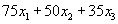 |
where x 1, x 2, and x 3 are decision variables. The variables are multiplied by coefficients [75, 50, and 35 in equation (2.12)] that are constant in the optimization problem. They may be computed in an Excel spreadsheet. Linear programming problems are intrinsically easier to solve than NLP problems. In an NLP model, there may be more than one feasible region, and the optimal solution might be found at any point within any such region. In contrast, an LP model has at most one feasible region with "flat faces." Some simpler problems may be solved graphically. A typical example related to a heater is given in the following section.
A fired heater having an operating capacity of 500 t/h of feed uses fuel gas and fuel oil to heat the feed to the outlet temperature of 345 C. The calorific value of fuel oil is 9,900 kcal/kg, and that of fuel gas is 10,800 kcal/kg. Cost of fuel oil is $100/t, while that of fuel gas is $60/t. Maximum fired duty of the heater is 100 mmkcal/h. From the standpoint of radiation temperature, the heater should have minimum 65% and maximum 90% oil firing. Atomizing steam is 15% of oil consumed, and...