Practical Energy Efficiency Optimization
Presenting basic information for optimizing power plants, this book uses review exercises and practical case studies to provide real-world applications on maintaining optimal efficiency.
 TABLE OF CONTENTS
 This will explain strategies for improving energy efficiency of power plants by operational changes and low-cost retrofits of the existing system. This will also show effects of operational changes in the efficiency of boiler, turbine, etc., using a model output. This will explain the role of operating parameters on energy efficiency of each system. It will explain optimal power plant operation strategy (system specific) from an energy efficiency standpoint.
Boilers are steam-producing devices used in the process and power generation units. Boilers where steam is generated to generate power alone (as in thermal power generation units) are called power boilers. Process boilers generally generate steam for process use, and excess steam is incidentally used for power generation also.
Air preheater (inlet air heated by flue gas)
Economizer (boiler feed water heated by flue gas)
Superheater (steam superheated by flue gas)
Induced draft/forced draft fans (air circulation devices)
High-efficiency burners (better atomization)
Auto damper control (air control device)
Oxygen monitor/combustion controller
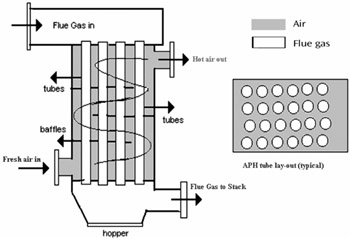
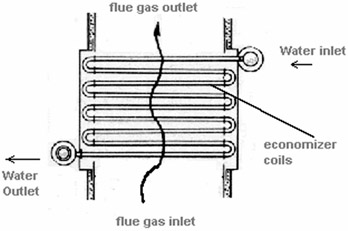
Figures D-1 through D-3 show a typical air preheater layout, an economizer layout, and a superheater. Figure D-1 shows how air passes in the shell side. Flue gas passes through tubes as shown. This increases thermal efficiency by 9 11%. In figure D-2 the main objective of economizer is to increase the thermal efficiency of the boiler by preheating boiler feed water by exhaust flue gases.
Superheater is designed...