Practical Energy Efficiency Optimization

Presenting basic information for optimizing power plants, this book uses review exercises and practical case studies to provide real-world applications on maintaining optimal efficiency.
 TABLE OF CONTENTS
 Compressors are mechanical devices used to increase the pressure of air/gas mixtures such as fuel gas, ammonia, air, hydrogen, etc., depending on the process requirement. Compressors are also used to transport huge volumes of gas to other sites/countries (transcontinental application). Compressors are either of the dynamic or positive displacement type.
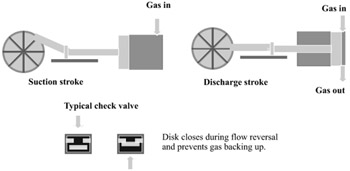
A reciprocating compressor is a positive displacement device. It compresses the gas in a piston. During the suction stroke, gas is sucked into the cylinder. By external energy applied to the crank wheel, the piston pressurizes the gas during discharge stroke. A check valve system prevents the gas from backing up from the cylinder to the suction side. During suction stroke, the gas header pressure will be zero and starts increasing when the gas gets compressed. This results in pressure pulsations/variations. See figures C-l and C-2.

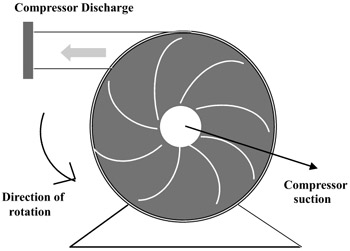
In conventional centrifugal compressors (fig. C-3), kinetic energy is converted into pressure energy. Gas enters axially at the center of the impeller and passes through the tip of the wanes, which are rotating at high speed. The gas picks up the velocity, and high pressure is achieved, when it expands at discharge.
In any continuous compression process, the relationship between absolute pressure to volume is given by

where P is absolute pressure of the...