Practical Energy Efficiency Optimization

Presenting basic information for optimizing power plants, this book uses review exercises and practical case studies to provide real-world applications on maintaining optimal efficiency.
 TABLE OF CONTENTS
 This appendix explains the techniques used in total energy efficiency optimization of the complex system designed to control and manage energy consumption/utilization of all forms of energy, i.e., fuel, steam, electricity and thermal energy related to process, power, steel, cement, paper, and glass industries. The CAEM (computer aided energy management) technique is adopted for these functions.
Energy efficiency optimization works on the principles of Pareto's theory. The total system is divided into a number of subsystems where energy input/output data from design and actual values are stored. Then, monitoring priorities are set automatically for the user.
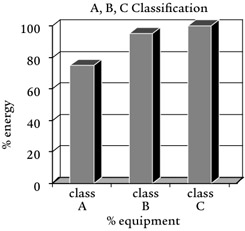
About 7 10% of the total equipment consumes 70 75% of total energy input to the system (class A)
About 30% of the equipment consumes 10% of total energy input (class B)
The balance 60 70 % of equipment consumes 6 7% of total energy input (class C)
By energy system analysis, class A, class B, and class C equipment of the total system are identified for performance monitoring. Then, performance models are developed for the subsystems from the energy database.
Pareto's model related to energy management offers a fast-track solution to energy management. It also monitors performance effectively and identifies specific problem area in a very short time. It offers tangible solutions.
This is a totally dedicated approach that covers the entire range of energy-consuming equipment for performance evaluation...