Practical Energy Efficiency Optimization

Presenting basic information for optimizing power plants, this book uses review exercises and practical case studies to provide real-world applications on maintaining optimal efficiency.
 TABLE OF CONTENTS
 A quadratic programming (QP) problem has an objective that is a quadratic function of the decision variables, and constraints are all linear functions of the variables. A typical example of a quadratic function is
| (2.36) |  |
where x 1 and x 2 are decision variables.
A widely used QP problem is the Markowitz mean-variance portfolio optimization problem using a number of normal equations. The linear constraints specify lower and upper bounds for profitability function. QP problems, like LP problems, have only one feasible region with "flat faces" on its surface (owing to the linear constraints), but the optimal solution may be found anywhere within the region or on its surface.
For example, two boilers B1 and B2 are designed to operate at maximum loads of 500 and 750 t/h, respectively. Their respective minimum turndown ratios are 65% and 55%. Boiler efficiency characteristics as a function of load for the two boilers are shown in figure 2-6.
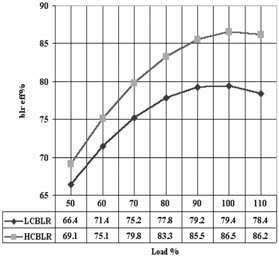
Find the optimal load on the two boilers when steam demand is 800, 900, and 1,000 t/h such that the overall efficiency is maximum. This may be represented as follows:
Efficiency of boiler B1: e 1 = a 1( x 1) 2 + b 1 x 1 + c 1
Efficiency of boiler B2: e 2 = a 2( x 2) 2 + b 2 x 2 + c 2
Overall efficiency of the...