Pro/ENGINEER ReferencePoint Suite

Pro/Piping is used to design three-dimensional (3-D) complex piping systems for industrial applications that comply with the requirements and constraints of a pipe design.
This ReferencePoint describes how to design piping systems in a 3-D environment using Pro/Piping. It also explains the various methods to route pipes, create line stocks, and pipe assemblies. In addition, it describes the various tools available to extract piping information and to modify the piping.
Piping design systems are used in process industries, industries that work with hydrostatic applications, and industries that design machinery with hydrostatic drive.
A piping system includes:
Straight pipes and tubes
Pipe fittings to connect pipe and tube segments
Flexible pipes, also known as hoses, used to carry pressurized fluids
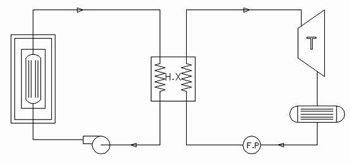
In a piping design, you route the pipes with the assemblies and obtain information about the length and fittings of the pipe required. An example of a piping design requirement is shown in Figure 2-7-1:
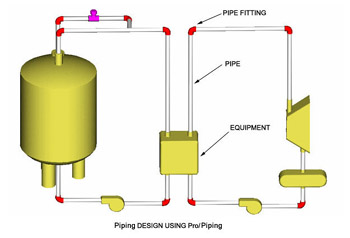
To design this piping system in Pro/Piping, you would place the pipelines in an optimized path between the process equipment or in a mechanical system with hydrostatic drive. This procedure is called routing a pipeline as shown in Figure 2-7-2:
You design the piping system using Pro/Engineer assemblies as a reference. Whenever there is a change in the base assembly, the piping system designed with Pro/Piping updates the design automatically.
You can use Pro/Piping...