Process Engineering Equipment Handbook
This is an illustrated guide to the major equipment found in chemical process plants, for engineers charged with operating, specifying and performing basic troubleshooting on the equipment in their environment.
 TABLE OF CONTENTS
 Measurement of temperature is generally considered to be one of the simplest and most accurate measurements performed in engineering. The desired accuracy in the measurement can be obtained, however, only by observing suitable precautions in the selection, installation, and use of temperature-measuring instruments and in the proper interpretation of the results obtained with them.
Four phenomena form the basis for most measuring instruments:
Change in physical dimensions or characteristics of liquids, metals, or gases
Changes in electrical resistance
Thermoelectric effect
Radiant energy
The following types of instruments are available for use under appropriate conditions:
Liquid-in-glass thermometer
Resistance thermometer
Thermocouple thermometer
Filled-system thermometer
Bimetallic thermometer
Radiation thermometer
Optical pyrometer
A liquid-in-glass thermometer consists of a thin-walled glass bulb attached to a glass capillary stem closed at the opposite end, with the bulb and a portion of the stem filled with an expansive liquid, the remaining part of the stem being filled with the vapor of the liquid or a mixture of this vapor and an inert gas. Etched on the stem is a scale in temperature degrees so arranged that, when calibrated, the reading corresponding to the end of the liquid column indicates the temperature of the bulb. The three types of liquid-in-glass thermometers (Fig. M-1) are partial-immersion, total-immersion, and complete-immersion thermometers.
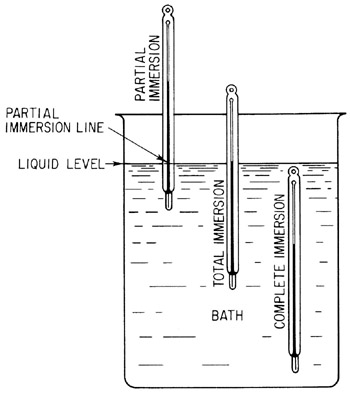
A partial-immersion thermometer is designed to indicate temperature...