Process Engineering Equipment Handbook
This is an illustrated guide to the major equipment found in chemical process plants, for engineers charged with operating, specifying and performing basic troubleshooting on the equipment in their environment.
 TABLE OF CONTENTS
 The term seals is commonly used to refer to seals in pumps and other turbo- machinery. The more complex the application, the more complex the seal. Instructions on seal working methods, maintenance, and so forth are provided with seal OEM (original equipment manufacturer) manuals. In the case of simple pumps, the process engineer may have the option of using different bearings and seals than the ones that came with the original equipment. An example is simple grease- packed bearings that are "standard" for a specific shaft size. The best source of information for standards seals is seal vendors' catalogues.
In special applications that are potentially poisonous and explosive, the seal-oil system design may be customized with a purge-oil system that provides a buffer against the hazard and prevents leakage. Major seal vendors have seal models that will have appropriate jets and clearances for these applications.
Figures S-1 and S-2 illustrate the standard and advanced product features of gas seals.
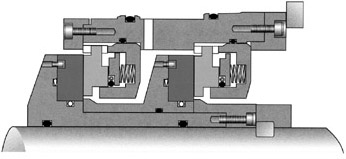
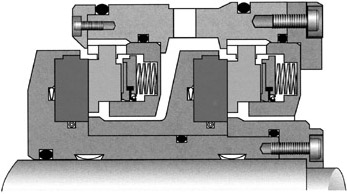
Rotating face centering In both standard and advanced configurations, the rotating face is centered by a spiral spring to ensure concentricity with the seal shaft sleeve. The spiral centering spring is designed to provide a centering force that always exceeds the eccentric force. The spiral centering spring allows for even force distribution around the entire inner diameter of the rotating face. This...