Process Engineering Equipment Handbook
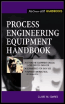
This is an illustrated guide to the major equipment found in chemical process plants, for engineers charged with operating, specifying and performing basic troubleshooting on the equipment in their environment.
 TABLE OF CONTENTS
 Power transmission is the act of taking power from a driving piece of equipment (such as a gas turbine, steam turbine, or motor) and transmitting it to a driven piece of equipment (such as a compressor or a pump). Power-transmission equipment then includes gears and gearboxes, couplings, and other systems that transmit power from the "driver" to the "driven."
In this section, model numbers used by the information source companies will appear, as in other sections in this book. Care was taken to get source information from suppliers with the widest product ranges currently available, so the reader can then use this information as a basis for comparison with other OEMs being considered.
Gears are associated with nearly every human activity in the modern world. They come in all sizes, shapes, and materials. They go by such names as spur, helical, bevel, hypoid, worm, skew, internal, external, epicyclic, and so on.
The following material is presented to assist an engineer who is not a gear specialist in determining the basic size and requirements of a gearset for one specific type of gearing: high-speed, high-power parallel-axis gears. The industry definition of high speed is 3600 rpm and/or 5000 ft/min pitch-line velocity. In this instance, high power means from 1000 to 2000 hp at the low end and upward of 50,000 hp at the high end. The kinds of applications that generally require high-speed gearing are those involving steam and gas turbines, centrifugal pumps...