Programmed Review for Electrical Engineering, Third Edition
This text contains an organized review of the basic electrical engineering fundamentals, with 111 problems, solutions and explanations for the core electrical engineering concepts.
 TABLE OF CONTENTS
 Discussions of and problems related to series-wound dc motors, shunt-wound dc motors, series-shunt-wound dc motors, shunt motor torque, induction motor speed, induction motor efficiency, induction motor losses, motor starting line voltage drop, transformer efficiency and regulation, regulation improvement, autotransformers, and magnetic devices.
Electrical machinery may be divided into two categories: dc and ac. Dc machinery consists, broadly, of motors and generators, whereas ac machinery consists of motors, generators, and transformers.
Most PE Exam problems deal with motors and transformers. Generators are almost totally ignored since their characteristics, in principle, are nearly identical to those of motors. Many varieties of motors are available to fit the myriad applications.
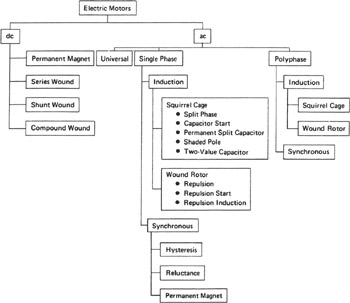
Table 4-1 categorizes basic electric motors by type. Detailed characteristics are summarized in handbooks available from many motor manufacturers. Transformers also may be classified by phase (single phase or polyphase) and type (two-winding or autotransformer). The problems in this chapter illustrate the features and parameters of rotating machinery and transformers.
|
 |
Dc motors and generators consist of an armature, a field, a commutator, and poles. The typical dc generator uses stationary electromagnets for producing the fields. Conductors for the generation of emf are carried on a rotating element called the armature.
The instantaneous emf induced in a conductor of length l moving with a velocity v within and perpendicular to a magnetic field of density B is:
e = Blv
Also, the force on a conductor of length l