Programmed Review for Electrical Engineering, Third Edition
This text contains an organized review of the basic electrical engineering fundamentals, with 111 problems, solutions and explanations for the core electrical engineering concepts.
 TABLE OF CONTENTS
 Discussions of and problems related to number systems, truth functions, Boolean algebra, switching devices, minimization of Boolean functions, codes and special realizations, and sequential circuits.
The PE Examinations are now beginning to include digital logic. Questions in digital logic can be expected to be included in future PE Exams.
This chapter presents general principles with which you should be familiar.
A basic review of the field should include the following subjects:
Number Systems
Bases other than 10
Conversion between bases
Negative numbers
Truth Functions
Logical reasoning
Binary connectives
Physical realizations (AND, OR, NOT; inclusive/exclusive OR)
Boolean Algebra
Huntington's postulates, duality
Truth calculus vs. Boolean algebra (+, X, )
DeMorgan's theorem
Venn diagram
Boolean simplification
Switching devices
Gates
Flip-flops
Minimization of Boolean functions
Terms (literal, product, sum, normal, conjunction, disjunction)
Minterms and maxterms, prime implicants
Karnaugh map (graphical method of minimization)
Quine-McClusky method (tabular method of minimization)
Codes and Special Realizations
Error detection and correction
Parity check
Adder (half, full)
BCD
Gray (reflected)
Excess-3
Hamming
Distance
Sequential Circuits
Shift registers
Counters
Clocked circuits, sequencers
Timing considerations
State diagrams
Mealy-Moore translations and circuits
Cycles, races, hazards
The following terms are used in the field of logic design:
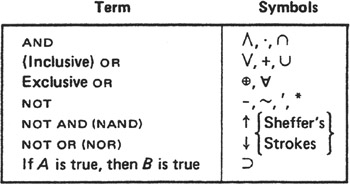
| Connective | ^ | A | B | ? | V | ? | ? | | | ? | ? | ||||||
|---|---|---|---|---|---|---|---|---|---|---|---|---|---|---|---|---|---|
| A | B | 0 | 1 | 2 | 3 | 4 | 5 | 6 | 7 | 8 | 9 | 10 | 11 | 12 | 13 | 14 | 15 |
| 0 | 0 | 0 | 0 | 0 | 0 | 0 | 0 | 0 | 0 |