Programmed Review for Electrical Engineering, Third Edition

This text contains an organized review of the basic electrical engineering fundamentals, with 111 problems, solutions and explanations for the core electrical engineering concepts.
 TABLE OF CONTENTS
 Discussion of and problems related to diode suppression, one-stage transistor amplifier, common base amplifier, two-stage transistor amplifier, transistor curves and load line, transistor stability, field effect transistor amplifier, vacuum tube amplifier, operational amplifer, and amplifier class.
Only the most basic aspects of electronics are presented as they relate to the type of problems found in the PE Exam. Reference to a basic college text on electronics may be helpful in reviewing this subject.
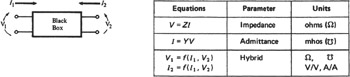
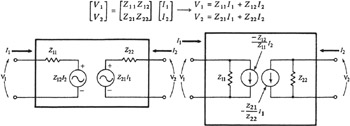
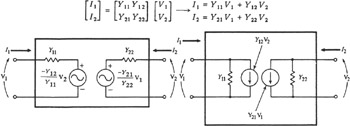
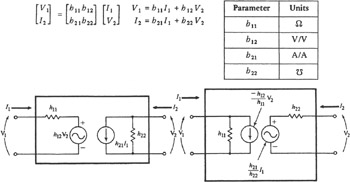
A circuit may be represented by a black box having an input and an output with its parameters expressed in several ways, as illustrated by the models below.
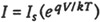
The classical diode equation is:

where
| I s | = | saturation current |
| q | = | charge on an electron = 1.602 10 -19 coulomb |
| k | = | Boltzmann's constant = 1.38 10 -16 erg/ K |
| T | = | temperature in K ( K = C + 273) |
| V | = | forward voltage across the diode |
If V is about four times greater than kT/q (say 0.1 volt), the diode equation simplifies to:
and the dynamic forward resistance at a specific operating point is:

At room temperature, kT/q is approximately 26 mV; thus, a diode with 1 mA of forward current will exhibit 26 ohms of dynamic resistance.
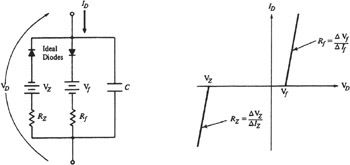
The following are diode models, characteristics, and applications.
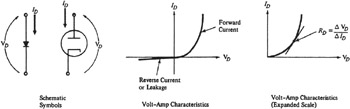
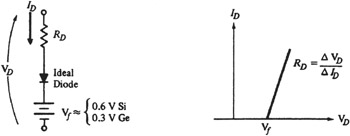
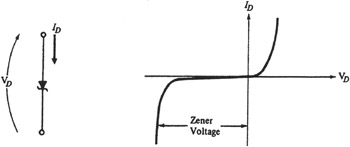
Q:
A...