Quantum Transport: Atom to Transistor

Chapter 4: Basis Functions

Overview

We have seen that it is straightforward to calculate the energy levels for atoms using the SCF method, because the spherical symmetry effectively reduces it to a one-dimensional problem. Molecules, on the other hand, do not have this spherical symmetry and a more efficient approach is needed to make the problem numerically tractable. The concept of basis functions provides a convenient computational tool for solving the Schr dinger equation (or any differential equation for that matter). At the same time it is also a very important conceptual tool that is fundamental to the quantum mechanical viewpoint. In this chapter we attempt to convey both these aspects.

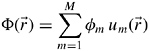
The basic idea is that the wavefunction can, in general, be expressed in terms of a set of basis functions, u m( )


We can then represent the wavefunction by a column vector consisting of the expansion coefficients


In spirit, this is not too different from what we did in Chapter 2 where we represented the wavefunction by its values at different points on a discrete lattice:


However, the difference is that now we have the freedom to choose the basis functions u m( ): if we choose them to look much like our expected wavefunction, we can represent the wavefunction accurately with just a few terms, thereby reducing the size of the resulting matrix [ H] greatly. This makes the approach useful as a computational tool (similar in spirit to the concept of "shape functions" in the finite element method...

UNLIMITED FREE
ACCESS
TO THE WORLD'S BEST IDEAS

SUBMIT
Already a GlobalSpec user? Log in.

This is embarrasing...

An error occurred while processing the form. Please try again in a few minutes.

Customize Your GlobalSpec Experience

Category: Aspheric Lenses
Finish!
Privacy Policy

This is embarrasing...

An error occurred while processing the form. Please try again in a few minutes.