Quantum Transport: Atom to Transistor

10.3: Inflow and Outflow

10.3 Inflow and Outflow

Let me now explain how we can use the concepts developed in this chapter to write down the new terms and ? s appearing in Fig. 10.2 (p. 252).

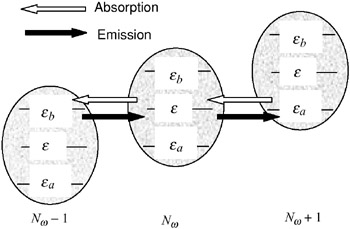
Discrete levels: To start with, consider the inflow and outflow into a specific energy level ? due to transitions from levels a and b one above it and one below it separated by an energy of (Fig 10.3.1). We saw in Section 10.1 that the rate constant ( K ab) for absorption processes is proportional to the number of phonons present ( N ?) while the rate constant ( K em) for emission processes is proportional to ( N ? + 1). Let s assume the temperature is very low compared to ? ?, so that N ? ? 1 and we need only worry about emission. Using N, N a, and N b to denote the number of electrons in each of these levels we can write for the level ?:


Fig. 10.3.1: An idealized device with three levels used to write down the inflow and outflow terms due to the absorption and emission of photons and phonons.

We can now write the inflow term as a difference between two terms


where the second term represents the part of the inflow that is blocked by the exclusion principle. A non-obvious result that comes out of the advanced formalism (see...

UNLIMITED FREE
ACCESS
TO THE WORLD'S BEST IDEAS

SUBMIT
Already a GlobalSpec user? Log in.

This is embarrasing...

An error occurred while processing the form. Please try again in a few minutes.

Customize Your GlobalSpec Experience

Category: Nanomaterials
Finish!
Privacy Policy

This is embarrasing...

An error occurred while processing the form. Please try again in a few minutes.