Quantum Transport: Atom to Transistor

10.1: Why Does an Atom Emit Light?

10.1 Why Does an Atom Emit Light?

We started this book by noting that the first great success of the Schr dinger equation was to explain the observed optical spectrum of the hydrogen atom. It was found that the light emitted by a hot vapor of hydrogen atoms consisted of discrete frequencies ? = 2 ? ? that were related to the energy eigenvalues from the Schr dinger equation: ? ? = ? n ? ? m. This is explained by saying that if an electron is placed in an excited state 2 , it relaxes to the ground state 1 , and the difference in energy is radiated in the form of light or photons (Fig. 10.1.1). Interestingly, however, this behavior does not really follow from the Schr dinger equation, unless we add something to it.


Fig. 10.1.1: If an electron is placed in an excited state 2 , it will lose energy by radiating light and relax to the ground state 1 . However, this behavior does not follow from the Schr dinger equation, unless we modify it appropriately.

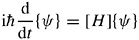
To see this let us write the time-dependent Schr dinger equation (Eq. (2.1.8)) in the form of a matrix equation

(10.1.1)

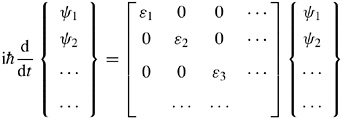
using a suitable set of basis functions. If we use the eigenfunctions of [ H] as our basis then this equation has the form:


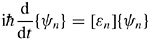
which decouples neatly into a set of independent equations:

(10.1.2)

one for each energy eigenvalue ? n. It is easy to write down...

UNLIMITED FREE
ACCESS
TO THE WORLD'S BEST IDEAS

SUBMIT
Already a GlobalSpec user? Log in.

This is embarrasing...

An error occurred while processing the form. Please try again in a few minutes.

Customize Your GlobalSpec Experience

Category: Radiation Detectors
Finish!
Privacy Policy

This is embarrasing...

An error occurred while processing the form. Please try again in a few minutes.