In Chapter 1, I used the generic structure shown in Fig. 11.1.1a (see Section 11.1.1) to focus and motivate this book. We spent Chapters 2 through 7 understanding how to write down a Hamiltonian matrix [ H 0] for the active region of the transistor structure whose eigenvalues describe the allowed energy levels (see Fig. 11.1.1b). In Chapter 8, I introduced the broadening [ ? 1] and [ ? 2] arising from the connection to the source and drain contacts. In Chapter 9, I introduced the concepts needed to model the flow of electrons, neglecting phase-breaking processes. In Chapter 10 we discussed the nature and meaning of phase-breaking processes, and how the resulting inflow and outflow of electrons is incorporated into a transport model. We now have the full machinery needed to describe dissipative quantum transport within the self-consistent field model (discussed in Chapter 3) which treats each electron as an independent particle moving in an average potential U due to the other electrons. I should mention, however, that this independent electron model misses what are referred to as strong correlation effects (see Section 1.5) which are still poorly understood. To what extent such effects can be incorporated into this model remains to be explored (see Appendix, Section A.5).
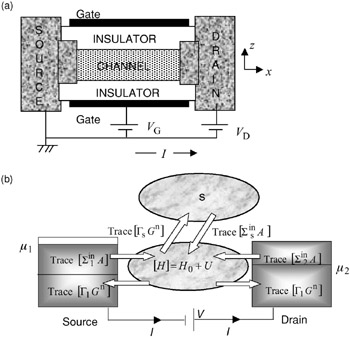 Fig. 11.1.1: (a) The generic transistor structure we used in the introduction to motivate this book. (b) Inflow and outflow of electrons for the generic structure in (a).
 My purpose in this chapter is to summarize...
Copyright S. Datta 2005 under license agreement with Books24x7


 TABLE OF CONTENTS



