Quantum Transport: Atom to Transistor

10.2: Examples

10.2 Examples

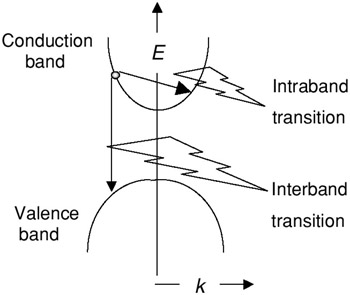
In this section I will go through a few examples to illustrate the basic approach for describing incoherent interactions. I will take up the more general case of inflow and outflow in Section 10.3, but in this section I will assume all other states to be empty so that there is no exclusion principle to worry about and I will calculate the broadening (or the outflow), which can be identified with ?/ ?, ? being the lifetime of the state. This will include: (1) the photon-induced (radiative) lifetime due to atomic transitions; (2) the radiative lifetime due to interband transitions in semiconductors; and (3) the phonon-induced (non-radiative) lifetime due to intraband transitions in semiconductors (Fig. 10.2.1). The basic approach is to write down the interaction potential (see Eq. (10.1.14)), evaluate the coupling constants (see Eq. (10.1.15)), and obtain the broadening and hence the lifetime from Eq. (10.1.13).


Fig. 10.2.1: Electronic transitions in semiconductors can be classified as interband and intraband. The former are associated primarily with electron photon interactions while the latter are associated primarily with electron phonon interactions.

10.2.1 Atomic transitions

From Eq. (10.1.13) it is apparent that the broadening is large when the argument of the delta function vanishes. How large it is at that point depends on the value of 0 + (see Section 8.4) that we choose to broaden each reservoir state. As we have seen in Chapter 8, the precise value of 0 + usually does not matter as long...

UNLIMITED FREE
ACCESS
TO THE WORLD'S BEST IDEAS

SUBMIT
Already a GlobalSpec user? Log in.

This is embarrasing...

An error occurred while processing the form. Please try again in a few minutes.

Customize Your GlobalSpec Experience

Category: Photovoltaic Cells
Finish!
Privacy Policy

This is embarrasing...

An error occurred while processing the form. Please try again in a few minutes.