I started this book with a simple problem: two contacts are made to a really small object having just one energy level in the energy range of interest. A voltage V is applied between the contacts so that their electrochemical potentials separate, 1 ? 2 = qV (see Fig. 1.2.2). What is the current? We saw that this question could be answered on the basis of two equations describing the current flow at the two interfaces (See Eqs. (1.2.3a, 1.2.3b)), provided we included the broadening of the energy levels that accompanies the process of coupling.
The essential point behind these equations is that there is an outflow from the contact and an inflow from the contact (Fig. 12.1) whose difference equals the rate at which the number of electrons changes:
| (12.1) | 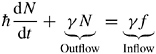
|
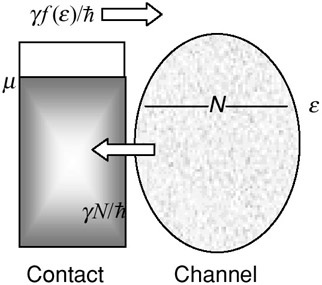 Fig. 12.1
 In Chapters 8 and 9 we discussed a quantum mechanical treatment of this problem based on the one-electron Schr dinger equation
| (12.2) | 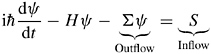
|
with an additional self-energy term ? ? and a source term S that give rise to outflow and inflow respectively ((Eq. (8.2) in Chapter 8 can be viewed as the Fourier transform of this equation). Traditional quantum mechanics courses focus on the Hamiltonian [ H] describing the internal dynamics of electrons in a closed system, just as we did in Chapters 2 through 7 of this book. But from Chapter 8 onwards we have been discussing different aspects of inflow and outflow, since it is so central to...
Copyright S. Datta 2005 under license agreement with Books24x7


 TABLE OF CONTENTS