Quantum Transport: Atom to Transistor

In the last chapter we saw how the atomic orbitals can be used as a basis to write down a matrix representation for the Hamiltonian operator, which can then be diagonalized to find the energy eigenvalues. In this chapter we will show how this approach can be used to calculate the energy eigenvalues for an infinite periodic solid. We will first use a few toy examples to show that the bandstructure can be calculated by solving a matrix eigenvalue equation of the form
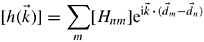
where
The matrix [ h(
)] is ( b b) in size, b being the number of basis orbitals per unit cell. The summation over m runs over all neighboring unit cells (including itself) with which cell n has any overlap (that is, for which H nm is non-zero). The sum can be evaluated choosing any unit cell n and the result will be the same because of the periodicity of the lattice. The bandstructure can be plotted out by finding the eigenvalues of the ( b b) matrix [ h(
)] for each value of
and it will have b branches, one for each eigenvalue. This is the central result which we will first illustrate using toy examples (Section 5.1), then formulate generally for periodic solids (Section 5.2), and then use to discuss the bandstructure of 3D semiconductors (Section 5.3). We discuss spin orbit coupling and its effect on the energy...