RF Power Amplifiers
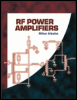
In this comprehensive reference, the author presents a full account of RF amplifiers and shows that understanding large-signal RF circuits is simply a matter of understanding the basic principles and their applications.
 TABLE OF CONTENTS
 Chapter 2 discusses several types of RF power amplifiers (PAs), most often called Class A, AB, B, and C. Class C amplifiers, in turn, are usually divided into three categories: a) current-source (or underdriven) Class C PAs, b) saturated (or overdriven) Class C PAs, and c) mixed-mode Class C PAs. With the exception of mixed-mode Class C PAs, which behave somewhat differently, the other circuits have the following common features:
They have the same basic collector circuit schematic, as shown in Figure 2-1.
The circuits are all driven with sinusoidal (or approximately sinusoidal) waveforms.
The active device behaves, at least for a certain portion of the RF cycle, as a controlled-current source.
The portion of the RF cycle the device spends in its active region (i.e., behaves as a controlled-current source) is the conduction angle and is denoted by 2 q c. Based on the conduction angle, the amplifiers are generally classified as [1-10]:
Class A amplifiers, if 2 q c = 360 . The active device is in its active region during the entire RF cycle.
Class AB amplifiers, if 180 < 2 q c < 360 .
Class B amplifiers, if 2 q c = 180 .
Class C amplifiers, if 2 q c < 180 . Note that, in saturated Class C amplifiers, the conduction angle includes the portion of the RF cycle when the active device is saturated.
All these amplifiers use the same basic collector circuit topology of Figure 2-1. This is...