RF Power Amplifiers
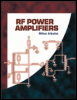
In this comprehensive reference, the author presents a full account of RF amplifiers and shows that understanding large-signal RF circuits is simply a matter of understanding the basic principles and their applications.
 TABLE OF CONTENTS
 Many applications that do not require linear amplification of the input signal as obtained in Class A, push-pull Class B, or AB amplifiers. Examples of such applications are the amplification of CW or FM signals or amplifiers for AM signals using collector amplitude modulation. Class C amplifiers have an important advantage because their collector efficiency is higher than that obtained in Class A, B, or AB amplifiers. The major disadvantages, with respect to the previously discussed amplification classes, are a higher harmonic content of the output that may require additional filtering and a lower power gain.
The literature on Class C amplifiers contains a large number of models and analyses of this circuit [1-10, 12-24]. Some of these analyses use complicated models for the active device (usually modified small-signal hybrid-pi or Ebers-Moll models). For the most part, analytic solutions for the resulting equations cannot be found and numerical computation is often required. Despite their complexity, these analyses have limited utility because some of their initial assumptions cannot be adapted for real circuits. Also, none of these analyses provide circuit design equations.
One of the most popular analysis techniques approximates the collector current waveform with a portion of a sine wave when the transistor is active [1, 2, 4, 5, 8, 9, 12, 13, 14]. The collector current is zero when the transistor is cut off. If the transistor does not saturate during the RF cycle, the regime is called current-source Class C or underdriven...