RF Power Amplifiers
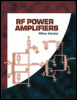
In this comprehensive reference, the author presents a full account of RF amplifiers and shows that understanding large-signal RF circuits is simply a matter of understanding the basic principles and their applications.
 TABLE OF CONTENTS
 Small-signal low-frequency amplifiers are often designed using some type of equivalent circuit for the transistor. (The most popular, by far, is the small-signal hybrid-pi model.) This technique also may be used at high frequencies. However, it is very difficult to accurately estimate the model parameters of the equivalent circuit, and this model is therefore rarely used. The most common RF small-signal amplifier design procedure is based on small-signal two-port parameters ( y- or s-parameters). This is a systematic, mathematical procedure with an exact solution and can be applied to any active linear device. Unfortunately, these parameters are useless for the design of very nonlinear RF PAs. Table 2-2 illustrates this with a comparison of the parameters of a BJT measured for small-signal linear operation and large-signal Class C operation [29].
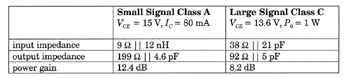
A considerable change occurs for the input impedance. The output resistance and power gain are also considerably different for the two modes of operation. This example clearly shows that small-signal parameters of the active device are not useful in high-power applications. [5] The small-signal s-parameter design method has led to the large-signal s-parameter technique [30, 31]. However, practical use is limited by two factors.
Large-signal s-parameters are much more difficult to measure accurately than small-signal s-parameters, especially for high-power devices.
There is no evidence of successful use of large-signal s-parameters in designing...