RF Power Amplifiers
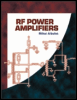
In this comprehensive reference, the author presents a full account of RF amplifiers and shows that understanding large-signal RF circuits is simply a matter of understanding the basic principles and their applications.
 TABLE OF CONTENTS
 It is desirable to obtain high RF power amplifier efficiency in many practical applications. At least one, if not all, of the following requirements is important: low power consumption (especially for battery-operated equipment), low temperature rise of the components, high reliability, small size, and light weight. Although the parasitic energy losses in, for example, inductors and capacitors are sometimes important, the major power loss in power amplifiers is usually due to power dissipated in the transistor(s). This was true for the Class A, B, and C PAs (their theoretical collector efficiency was calculated in Sections 2.1 through 2.3). Minimization of the power dissipated in the transistor(s) can be achieved by [1, 2]
minimizing the voltage across the transistor when current flows through it, and the current through the transistor when voltage exists across it,
minimizing the time intervals when large currents and voltages are applied simultaneously to the transistor.
Increased Class C amplifier efficiency is obtained by applying option a. above. During the large collector pulse, the collector-emitter voltage is low; on the other hand, the transistor is cut off when the collector voltage is high. The Class D PA further increases collector efficiency over that of the Class C amplifier by applying both options a. and b. First, the transistors are alternately cut off or saturated; either the voltage during the ON state or the current during the OFF state is negligible (see Figure 4-1). [1] Second, the switching times (when appreciable voltage and current are applied...