RF System Design of Transceivers for Wireless Communications
Addressing specifications that are critical for the design process, this book develops systematic methods for RF systems design, complete with a comprehensive set of design formulas.
 TABLE OF CONTENTS
 A system refers to any entity that produces a unique output in response to a legitimate input. In wireless communications, communication channels, base stations, mobile stations, receivers, transmitters, frequency synthesizers, and even filters all are physical systems with different complexity. Mathematically, a system can be described in
| (2.1.1) | 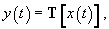 |
where x( t) is the input (or excitation), y( t) is the output (or response), t is an independent variable usually representing time, and T is the operation performed by the system. Then the system is also viewed as a transformation (or mapping) of x( t) into y( t).
A system is linear if and only if the principle of superposition holds i.e., its output can be expressed as a linear combination of responses to individual inputs:
| (2.1.2) |  |
where ? 1and ? 2are arbitrary scalars. A system that does not satisfy the superposition relationship (2.1.2) is classified as nonlinear.
There is a class of linear systems called linear time-invariant ( LTI) systems that play particularly important role in communication system theory and design. A system is referred to as time-invariant if a time shift, ?, in the input signal x( t- ?) causes the same time shift in the output signal y( t). This is expressed as
| (2.1.3) |  |
where L is LTI system operator. LTI systems provide accurate models for a large...