RF System Design of Transceivers for Wireless Communications
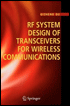
Addressing specifications that are critical for the design process, this book develops systematic methods for RF systems design, complete with a comprehensive set of design formulas.
 TABLE OF CONTENTS
 At present, it is still not practical for mobile stations to use the socalled software radio architecture, which should ideally have the ADC placed in the RF front-end near the antenna as possible and operating at an RF sampling frequency slightly higher than twice the greatest carrier frequency of interest, and the resulting samples are processed on a programmable signal processor. For a 1.9 GHz PCS band signal, the sampling rate of the ADC in the ideal software radio should be greater than 4.0 GHz. The main issue here is that the current technology is not mature enough to provide a device of processing samples at such a high rate and with acceptable power consumption for mobile stations. An alternate solution is to use the band-pass sampling architecture, which possibly possesses some features of the ideal software radio.
The band-pass sampling also referred to as harmonic sampling is the techniques of sampling at rates lower than the highest frequency of interest to achieve frequency conversion from RF to low IF or base-band through intentional aliasing and to be able to exactly reconstruct the information content of the sampled analog signal if it is a band-pass signal [19], [20] and [21]. The sampling rate requirement is no longer based on the RF carrier, but rather on the information bandwidth of the signal. Thus the resulting processing rate can be significantly reduced.
The radio architecture will be much simpler than the other architectures...