RF System Design of Transceivers for Wireless Communications
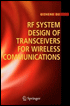
Addressing specifications that are critical for the design process, this book develops systematic methods for RF systems design, complete with a comprehensive set of design formulas.
 TABLE OF CONTENTS
 The IF in the low IF radio architecture is system dependent, and it can be as low as, e.g., half of two times the bandwidth of the desired signal. The main advantage of the low IF architecture over the direct conversion one is that this architecture has no DC offset problem because the desired signal is off the DC by the IF. Properly choosing the low IF can remove the low-frequency interference product that resulted from the down-converter second-order nonlinearity demodulating AM interferer out of the desired signal bandwidth. In addition, the low IF architecture is also able to significantly reduce the near DC flicker noise impact on the receiver performance. This architecture, thus, is quite attractive for the highly integrated transceivers based on the CMOS technology since the flicker noise in the CMOS circuits is much higher than that in the GaAs, BiCMOS, and SiGe circuits. The main drawback of this architecture is the image-rejection problem because the IF is so low that the image band interference is close to the desired signal and it is difficult to separate the image from the desired signal by using any passive UHF BPF without degrading the receiver sensitivity.
The low IF architecture is used mainly in the receiver. In the transmitter, this architecture may not have apparent advantages over either the superheterodyne or the direct conversion architecture. A possible block diagram of the low IF architecture receiver [13], [14] is...