RF System Design of Transceivers for Wireless Communications
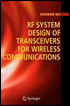
Addressing specifications that are critical for the design process, this book develops systematic methods for RF systems design, complete with a comprehensive set of design formulas.
 TABLE OF CONTENTS
 The direct conversion means that an RF signal is directly down-converted to a BB signal or vice versa without any intermediate frequency stages, and therefore it is also referred to as zero IF architecture. The direct-conversion receiver is also referred to as a homodyne when the LO is phase-locked with the carrier of the received signal. The direct-conversion architecture has many attractive features. The direct-conversion receiver has no IF, and thus the expensive IF passive filter (SAW filter) can be eliminated, and then the cost and size of the overall transceiver are reduced. The channel filtering of the direct-conversion receiver is implemented in the analog base-band by means of active low-pass filter. The bandwidth of the active filter can be designed as adjustable. Since the bandwidth of the channel LPF is adjustable, it is easy to design the direct-conversion receiver for multimode operation with a common analog base-band circuitry and even a common RF front-end from the preselector to the RF down-converter if all the modes running in the same frequency band. This architecture does not need a frequency plan, which is usually very time-consuming work and hard to validate. The direct conversion has no image.
The configuration of the direct-conversion radio looks simpler than that of the superheterodyne radio, but its implementation is much more difficult since there are a number of technical challenges in the direct conversion receiver. Compared with the receiver, the direct-conversion transmitter has fewer issues, and it...