RF System Design of Transceivers for Wireless Communications

Addressing specifications that are critical for the design process, this book develops systematic methods for RF systems design, complete with a comprehensive set of design formulas.
 TABLE OF CONTENTS
 In the weak and memoryless nonlinear case, we can use power series to model the nonlinearity of a device such as an amplifier or a mixer. If the input signal and output signal power of the device is P i and P o, respectively, then the output of the nonlinear device can be represented by its input as follows:
| (3A.1) | 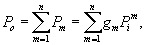 |
where g m ( m = 1, 2, , n) is the power gain when m =1, and the nonlinear gain coefficients when m ? l, and P m, is the m-th order distortion power of the total output power P o, and it is related to the input signal power P i as
| (3A.2) |  |
The power P i, P o, and P m ( m = 1, 2, , n) all are in natural scale. In the output terms of (3A.2), let us to look at two special cases i.e., the fundamental term and the mth order term as follows:
| (3A.3) |  |
and
| (3A.4) |  |
In fact, (3A.3) describes the linear relationship between the output and input, and (3A.4) is a generic high-order distortion representative. Converting (3A.3) and (3A.4) into dB scale, we obtain
| (3A.5) |  |
and
| (3A.6) |  |
where


Equation (3A.5) and (3A.6) represent two straight lines in the output power vs. input power plan as shown in Fig. 3A.1.