Linear Circuit Design Handbook

Section 6-2: ADC Architectures

Section 6-2: ADC Architectures

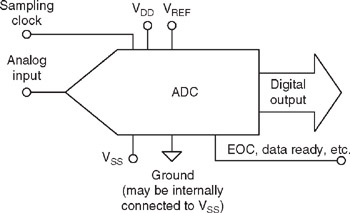
The basic ADC function is shown in Figure 6-42. This could also be referred to as a quantizer. Most ADC chips also include some of the support circuitry, such as clock oscillator for the sampling clock, reference (REF), the SHA function, and output data latches. In addition to these basic functions, some ADCs have additional circuitry built in. These functions could include multiplexers, sequencers, auto-calibration circuits, programmable gain amplifiers (PGAs), etc.


Figure 6-42: Basic ADC function

Similar to DACs, some ADCs use external references and have a reference input terminal, while others have an output from an internal reference. In some instances the ADC may have an internal reference that is pinned out through a resistor. This connection allows the reference to be filtered (using the internal R and an external C) or by allowing the internal reference to be overdriven by an external reference. The AD789X family of parts are examples of ADC that use this type of connection. The simplest ADCs, of course, have neither the reference is on the ADC chip and has no external connections.

If an ADC has an internal reference, its overall accuracy is specified when using that reference. If such an ADC is used with a perfectly accurate external reference, its absolute accuracy may actually be worse than when it is operated with its own internal reference. This is because it is trimmed for absolute accuracy when working with its own actual reference voltage, not with the nominal value. Twenty...

UNLIMITED FREE
ACCESS
TO THE WORLD'S BEST IDEAS

SUBMIT
Already a GlobalSpec user? Log in.

This is embarrasing...

An error occurred while processing the form. Please try again in a few minutes.

Customize Your GlobalSpec Experience

Category: Sample-and-Hold Amplifiers
Finish!
Privacy Policy

This is embarrasing...

An error occurred while processing the form. Please try again in a few minutes.