Linear Circuit Design Handbook

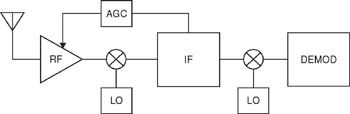
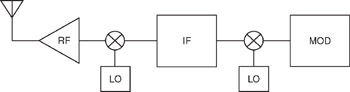
From cellular phones to two-way pagers to wireless Internet access, the world is becoming more connected, even though wirelessly. No matter the technology, these devices are basically simple radio transceivers (transmitters and receivers). In the vast majority of cases the receivers and transmitters are a variation on the superheterodyne radio shown in Figure 4-1 for the receiver and Figure 4-2 for the transmitter.
The basic concept of operation is as follows. For the receiver, the signal from the antenna is amplified in the radio frequency (RF) stage. The output of the RF stage is one input of a mixer. A local oscillator (LO) is the other input. The output of the mixer is at the intermediate frequency (IF). The concept here is that it is much easier to build a high gain amplifier string at a narrow frequency band than it is to build a wideband, high gain amplifier. Also, the modulation bandwidth is typically very much smaller than the carrier frequency. A second mixer stage converts the signal to the baseband. The signal is then demodulated (demod). The modulation technique is independent from the receiver technology. The modulation scheme could be amplitude modulation (AM), frequency modulation (FM), phase modulation, or some form of quadrature amplitude modulation (QAM), which is a combination of amplitude and phase modulation.
To put some numbers around it, let us consider a broadcast FM signal. The carrier frequency is in the...