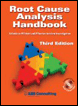
Root Cause Analysis Handbook: A Guide to Efficient and Effective Incident Investigation, Third Edition
Data analysis is at the heart of the investigation process. The goal of data analysis is to identify causal factors and their underlying root causes. For each causal factor, one or more root causes will be identified. Therefore, if a causal factor is not identified during this process, the investigators will miss multiple root causes later. The use of the structured tools addressed in this section will help investigators identify all of the causal factors.
Data analysis usually takes 15% to 25% of the analysis time, but it seems much longer because the data analysis techniques drive the data-collection process (covered in the last section). Data analysis focuses on organizing and judging the relevance of data collected and formulating a model of how the problem occurred. The methodologies covered in this section will also highlight gaps and inconsistencies in known data. This will lead the team to gather additional information to fill these gaps and resolve the inconsistencies.
The three basic steps in analyzing data are as follows:
Summarize the relevant facts brought forth through the data-gathering activities and separate fact from supposition
Develop a loss scenario model based on deductive and/or inductive reasoning approaches to identify causal factors, items of note, intermediate causes, and possible root causes for the incident
Verify the completeness and accuracy of the incident model (necessary and sufficient)
This section will describe three data analysis techniques:
Cause and effect trees
Timelines
Causal factor charts
The detailed methods...