Shop Reference for Students and Apprentices, Second Edition

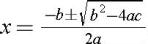
Solution of Quadratic Equations with One Unknown. If the form of the equation is ax 2 + bx + c = 0, then
Example: Given the equation, 1 x 2 + 6 x + 5 = 0, then a = 1, b = 6, and c = 5.
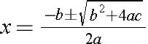
If the form of the equation is ax 2 + bx = c, then
Example: A right-angle triangle has a hypotenuse 5 inches long and one side which is one inch longer than the other; find the lengths of the two sides.
Let x = one side and x + 1 = other side; then x 2 + ( x + 1) 2 = 5 2 or x 2 + x 2 + 2 x + 1 = 25; or 2 x 2 + 2 x = 24; or x 2 + x = 12. Now referring to the basic formula, ax 2 + bx = c, we find that a = 1, b = 1, and c = 12; hence,
Since the positive value (3) would apply in this case, the lengths of the two sides are x = 3 inches and x + 1 = 4 inches.