Shop Reference for Students and Apprentices, Second Edition

Each dimension on a shop print represents a specific measurement required for the workpiece. Correctly reading and interpreting these dimensions requires an understanding and working knowledge of the tools and instruments used to make measurements in the shop.
Most shop measurements are classified as either linear measurements or angular measurements. Linear measurements are measurements of length and are typically expressed in units of inches or millimeters. Angular measurements are measurements of angles and are expressed in degrees and minutes.
[*]Portions of the chapter have been taken from Print Reading for Industry, by permission of the South-Western Publishing Co., Cincinnati, OH.
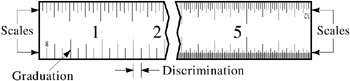
Steel Rules. The steel rule is the basic measuring tool used for linear measurements. This tool is a flat, thin strip of steel with evenly spaced marks along each edge. These marks are called graduations. Each series of marks, or lines, along the edges of the rule are called scales. The spacing of the graduations determines the discrimination of the scale, meaning the finest or smallest division of a scale that can be read reliably. For example, a steel rule with a fractional scale having eight divisions per inch has a discrimination of 1/8 inch. A scale with 64 divisions per inch has a discrimination of 1/64 inch. The most common scales used on steel rules have 8, 16, 32, and 64 graduations per inch. Other variations of the basic steel rule are the