Shop Reference for Students and Apprentices, Second Edition

Sharpening Twist Drills. Twist drills are cutting tools designed to perform concurrently several functions, such as penetrating directly into solid material, ejecting the removed chips outside the cutting area, maintaining the essentially straight direction of the advance movement and controlling the size of the drilled hole. The geometry needed for these multiple functions is incorporated into the design of the twist drill in such a manner that it can be retained even after repeated sharpening operations. Twist drills are resharpened many times during their service life, with the practically complete restitution of their original operational characteristics. However, in order to assure all the benefits which the design of the twist drill is capable of providing, the surfaces generated in the sharpening process must agree with the original form of the tool's operating surfaces, unless a change of shape is required for use on a different work material.
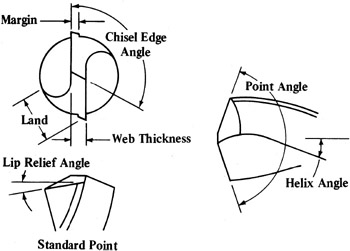
The principal elements of the tool geometry which are essential for the adequate cutting performance of twist drills are shown in Fig. 1. The generally used values for these dimensions are the following:
Point angle: Commonly 118 , except for high strength steels, 118 to 135 ; aluminum alloys, 90 to 140 ; and magnesium alloys, 70 to 118 .
Helix angle: Commonly 24 to 32 , except for magnesium and copper alloys, 10 to 30 .
Lip relief angle: Commonly 10 to 15 , except for high strength or tough steels,...