Signals and Systems with MATLAB Computing and Simulink Modeling, Fourth Edition
Chapter 1: Elementary Signals

This chapter begins with a discussion of elementary signals that may be applied to electric networks. The unit step, unit ramp, and delta functions are then introduced. The sampling and sifting properties of the delta function are defined and derived. Several examples for expressing a variety of waveforms in terms of these elementary signals are provided. Throughout this text, a left justified horizontal bar will denote the beginning of an example, and a right justified horizontal bar will denote the end of the example. These bars will not be shown whenever an example begins at the top of a page or at the bottom of a page. Also, when one example follows immediately after a previous example, the right justified bar will be omitted.

1.1 Signals Described in Math Form

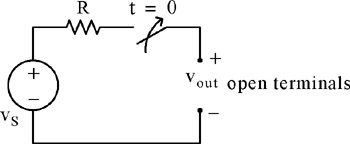
Consider the network of Figure 1.1 where the switch is closed at time t=0.


Figure 1.1: A switched network with open terminals

We wish to describe v out in a math form for the time interval ?? < t < + ?. To do this, it is convenient to divide the time interval into two parts, ?? < t < 0, and 0 < t < ?.

For the time interval ?? < t < 0, the switch is open and therefore, the output voltage v out is zero. In other words,


For the time interval 0 < t < ?, the switch is closed. Then, the input voltage v S

UNLIMITED FREE
ACCESS
TO THE WORLD'S BEST IDEAS

SUBMIT
Already a GlobalSpec user? Log in.

This is embarrasing...

An error occurred while processing the form. Please try again in a few minutes.

Customize Your GlobalSpec Experience

Category: Flip-Flops
Finish!
Privacy Policy

This is embarrasing...

An error occurred while processing the form. Please try again in a few minutes.