Signals and Systems with MATLAB Computing and Simulink Modeling, Fourth Edition
This chapter begins with the definition of the impulse response, that is, the response of a circuit that is subjected to the excitation of the impulse function. Then, it defines convolution and how it is applied to circuit analysis. Evaluation of the convolution integral using graphical methods is also presented and illustrated with several examples.
In this section we will discuss the impulse response of a network, that is, the output (voltage or current) of a network when the input is the delta function. Of course, the output can be any voltage or current that we choose as the output. The computation of the impulse response assumes zero initial conditions.
We learned in the previous chapter that the state equation
has the solution
Therefore, with initial condition x 0 = 0, and with the input u(t) = ?(t), the solution of (6.2) reduces to
Using the sifting property of the delta function, i.e.,
and denoting the impulse response as h(t), we obtain
where the unit step function u 0(t) is included to indicate that this relation holds for t > 0.
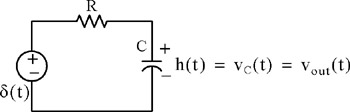
Compute the impulse response of the series RC circuit of Figure 6.1 in terms of the constants R and C, where the response is considered to be the voltage across the capacitor, and v C(0) - = 0. Then, compute the current through the capacitor.
Solution:
We assign currents...