Signals and Systems with MATLAB Computing and Simulink Modeling, Fourth Edition
This chapter presents applications of the Laplace transform. Several examples are presented to illustrate how the Laplace transformation is applied to circuit analysis. Complex impedance, complex admittance, and transfer functions are also defined.
In this section we will show the voltage-current relationships for the three elementary circuit networks, i.e., resistive, inductive, and capacitive in the time and complex frequency domains. They are shown in Subsections 4.1.1 through 4.1.3 below.
The time and complex frequency domains for purely resistive networks are shown in Figure 4.1.
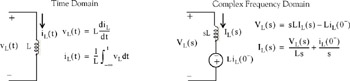
The time and complex frequency domains for purely inductive networks are shown in Figure 4.2.
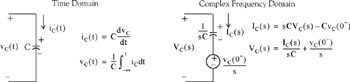
The time and complex frequency domains for purely capacitive networks are shown in Figure 4.3.
| Note | In the complex frequency domain, the terms sL and 1/sC are referred to as complex inductive impedance, and complex capacitive impedance respectively. Likewise, the terms and sC and 1/sL are called complex capacitive admittance and complex inductive admittance respectively. |
Use the Laplace transform method and apply Kirchoff s Current Law (KCL) to find the voltage v C(t) across the capacitor for the circuit of Figure 4.4, given that v C(0 -) = 6...