Signals and Systems with MATLAB Computing and Simulink Modeling, Fourth Edition
This chapter is devoted to discrete-time systems, and introduces the one-sided
Transform. The definition, theorems, and properties are discussed, and the
transforms of the most common discrete-time functions are derived. The discrete transfer function is also defined, and several examples are given to illustrate its application. The Inverse
transform, and the methods available for finding it, are also discussed.
The
performs the transformation from the domain of discrete-time signals, to another domain which we call z domain. It is used with discrete-time signals, [*] the same way the Laplace and Fourier transforms are used with continuous-time signals. The
transform yields a frequency domain description for discrete-time signals, and forms the basis for the design of digital systems, such as digital filters. Like the Laplace transform, there is the one-sided, and the two-sided
transform. We will restrict our discussion to the one-sided
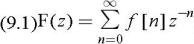
transform F(z) of a discrete-time function f[n] defined as
and the Inverse
transform is defined as
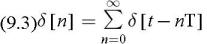
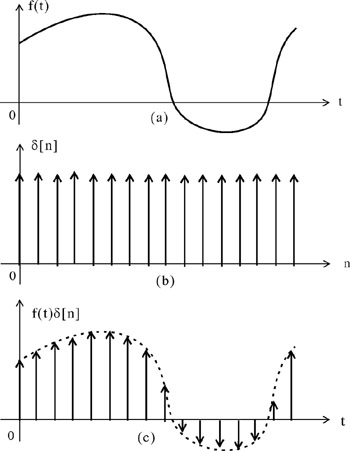
We can obtain a discrete-time waveform from an analog (continuous or with a finite number of discontinuities) signal, by multiplying it by a train of impulses. We denote the continuous signal as f(t), and the impulses as
Multiplication of f(t) by ?[n] produces the signal g(t) defined as
These signals are shown in Figure 9.1.
Of course, after multiplication by ?[n], the only values of f(t) which are not zero,...