Signals and Systems with MATLAB Computing and Simulink Modeling, Fourth Edition
This appendix is an introduction to window functions. We discuss the rectangular, triangular, Hanning, Hamming, Blackman, and Kaiser windows. An example using each is provided for illustration of their uses.
A window function is a function that is zero-valued outside of some chosen interval. For instance, a function that is constant inside the interval and zero elsewhere is called a rectangular window, and describes the shape of its graphical representation. When another function or a signal (data) is multiplied by a window function, the product is also zero-valued outside the interval: all that is left is the "view" through the window. Applications of window functions include spectral analysis, and filter design.
When selecting an appropriate window function for an application, a comparison graph may be useful. The most important parameter is usually the stop band attenuation close to the main lobe.
All of the window functions that we will discuss are even functions of time when centered at the origin.
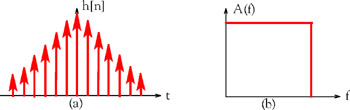
Based on the discussion in the previous section, it appears that a rectangular function would be the ideal window function to termina te an impulse response with an infinite number of terms. For instance, let us assume that the impulse response h[n] shown in Figure E.1(a) below converges uniformly and is represented by a portion of the amplitude response A(f) shown in Figure E.1(b).
Next, let us assume that...