This appendix is an introduction to matrices and matrix operations. Determinants, Cramer's rule, and Gauss's elimination method are reviewed. Some definitions and examples are not applicable to the material presented in this text, but are included for subject continuity, and academic interest. They are discussed in detail in matrix theory textbooks. These are denoted with a dagger ( ) and may be skipped.
D.1 Matrix Definition
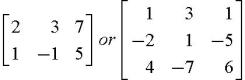
A matrix is a rectangular array of numbers such as those shown below.
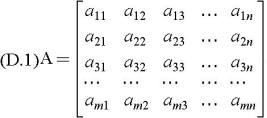
In general form, a matrix A is denoted as
The numbers a ij are the elements of the matrix where the index i indicates the row, and indicates the column in which each element is positioned. For instance, a 43 indicates the element positioned in the fourth row and third column.
A matrix of m rows and n columns is said to be of m n order matrix.
If m=n, the matrix is said to be a square matrix of order m (or n). Thus, if a matrix has five rows and five columns, it is said to be a square matrix of order 5.
In a square matrix, the elements a 11, a 22, a 33, , a nn are called the main diagonal elements. Alternately, we say that the matrix elements a 11, a 22, a 33, a nn, are located on the main diagonal.
The sum of the diagonal elements of a...

 TABLE OF CONTENTS