Signals and Systems with MATLAB Computing and Simulink Modeling, Fourth Edition
As stated earlier in this chapter, a digital filter, in general, is a computational process, or algo-rithm that converts one sequence of numbers representing the input signal into another sequence representing the output signal. Accordingly, a digital filter can perform functions as differentia-tion, integration, estimation, and, of course, like an analog filter, it can filter out unwanted bands of frequency.
In this section we provide several applications using Simulink models.
A given transfer function H(z) of a digital filter can be realized in several forms, the most common being the Direct Form I, Direct Form II, Cascade (Series), and Parallel. These are described in Subsections 11.6.1 through 11.6.4 below. Subsection 11.6.5 describes the Simulink Digital Filter Design block.
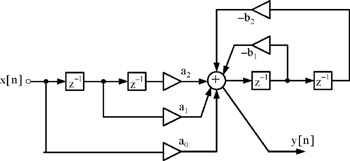
The Direct Form I Realization of a second-order digital filter is shown in Figure 11.48.
At the summing junction of Figure 11.48 we obtain
and thus the transfer function of the Direct Form I Realization of the second-order digital filter of Figure 11.48 is
A disadvantage of a Direct Form I Realization digital filter is that it requires 2k registers where k represents the order of the filter. We observe that the second-order (k=2) digital filter of Figure 11.48 requires 4 delay (register) elements denoted as z -1. However, this form of realization has the advantage that there is...