Smart Electronic Materials: Fundamentals and Applications
Chapter 4: Charge Transport in Materials

4.1 INTRODUCTION

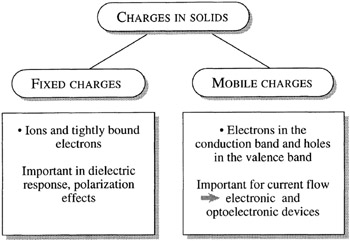
In this chapter we will examine how electrical current flows occur in materials. Electrical current can be carried by the transport of electron, holes, and even ions. These charges respond to applied electric fields and also move if there are concentration gradients. The transport phenomena is central in a number of important devices. The charges in a solid can be loosely classified as fixed and mobile. When an external perturbation is applied (e.g., an electric field) the mobile charges can move from one point in space to another. In particular they can move from one contact on a device to another. The fixed charge, however, can only be disturbed slightly from its equilibrium position, but cannot move over the length of a device. Both fixed charges and mobile charges play an important role in technology, as shown in Fig. 4.1. Essentially all electronic devices such as field effect transistors, bipolar transistors, diodes, as well as optoelectronic devices, such as lasers and detectors depend upon free or mobile charges. Mobile charges are the electrons in the conduction band and holes in the valence band for semiconductors and insulators. In some insulators with high defect densities, ions can carry current also, but the conductivity is very small. As we have discussed in previous chapters, in metals the mobile charges are the electrons in the conduction band.


Figure 4.1: An overview of fixed and mobile charges in solids and their impact on physical phenomena.

Fixed charges in materials also play...

UNLIMITED FREE
ACCESS
TO THE WORLD'S BEST IDEAS

SUBMIT
Already a GlobalSpec user? Log in.

This is embarrasing...

An error occurred while processing the form. Please try again in a few minutes.

Customize Your GlobalSpec Experience

Category: Cathode Emitters and Filaments
Finish!
Privacy Policy

This is embarrasing...

An error occurred while processing the form. Please try again in a few minutes.