Smart Electronic Materials: Fundamentals and Applications
Chapter 5: Light Absorption and Emission

5.1 INTRODUCTION

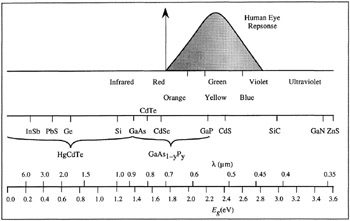
Light is an integral part of the human experience. Not only do we use light to find our way around this complex world, it also provides us a medium for art and fantasy. And, of course, it has been exploited for the important technology of communication, storage, and display. In contrast to other parts of the electromagnetic spectrum, the human eye directly detects light, giving the spectral range of 0.3 m to 1.0 m a special status. In Fig. 5.1 we show the electromagnetic spectrum and the region over which the human eye responds. Of course, while the human eye response window is important for display technology, there is great interest in infrared and far infrared (communication, night visions, etc.) and ultraviolet regions (high-density memory, lithography printing, etc.).


Figure 5.1: The bandgap and cutoff wavelengths for several semiconductors. The semiconductor bandgaps range from 0 (for Hg 0.4 Cd 0.15 Te) to well above 3 eV, providing versatile detection systems.

In Fig. 5.2 we show an overview of physical phenomenon governing devices that can detect and emit light. Three general categories are shown:

  1. In conventional inorganic semiconductor devices, light particles or photons create electrons and holes through absorption. The electrons and holes create an electrical signal that can be used to detect the radiation. Conversely, electrons and holes can recombine to emit photons. In semiconductors it is also possible to use bandgap trap levels to alter the photon energy. In this case the semiconductor...

UNLIMITED FREE
ACCESS
TO THE WORLD'S BEST IDEAS

SUBMIT
Already a GlobalSpec user? Log in.

This is embarrasing...

An error occurred while processing the form. Please try again in a few minutes.

Customize Your GlobalSpec Experience

Category: Radiation Detectors
Finish!
Privacy Policy

This is embarrasing...

An error occurred while processing the form. Please try again in a few minutes.