Smart Electronic Materials: Fundamentals and Applications
In the discussions of optical properties in semiconductors we have seen these are closely related to the density of states. In the gain term we have
| (5.43) | |
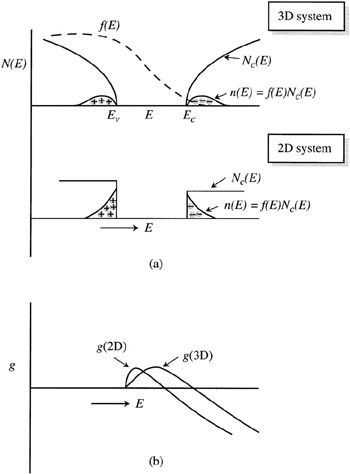
In three-dimensional systems the joint density of states is zero at the bandgap energy and increases monotonically. As a result the carrier distribution in a three-dimensional system (i.e. the product of density of states and occupation) has a form shown in Fig. 5.12a. The carrier distribution is given by
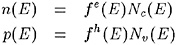
| (5.44) | |
The Fermi function is independent of dimensionality, but density of states can be modified by altering dimensionality. The gain in the three-dimensional system starts at zero at bandgap energy and peaks away from the bandgap as shown in Fig. 5.12b. For most optoelectronic applications we would prefer that the carrier distribution and gain peaks occur at the bandedge. This requires a modification of the density of states.
In Chapter 3, Section 3.7 we have seen that quantum wells made from semiconductors can alter electronic properties and density of states. Such modifications improve device performance as seen later and many high performance devices use quantum well systems. The reader should review Section 3.7.2 on quantum wells.
In Fig. 5.12 we show a schematic of carrier distribution and a gain curve in three- and two-dimensional systems. It is...