Smart Electronic Materials: Fundamentals and Applications
5.3: OPTICAL PROCESSES IN SEMICONDUCTORS

5.3 OPTICAL PROCESSES IN SEMICONDUCTORS

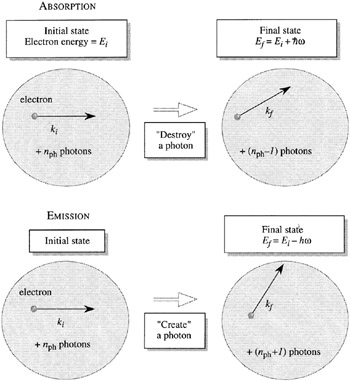
In this section we will consider the basic photon absorption and emission processes in semiconductors. To understand the optical processes we need not only to use the quantum description of electrons (i.e., band theory), but also the quantum description for light. In quantum mechanics, classical waves, such as electromagnetic waves, sound waves, etc., behave as particles, and this particle nature becomes critical under some conditions. Light waves, which are electromagnetic waves, behave as photons of energy ? ?. In simple processes electron-photon interaction changes the electron energy by + ? ? (absorption) or ? ? ? (emission), as shown in Fig. 5.5.


Figure 5.5: (a) A schematic of an absorption process, where a photon is absorbed (destroyed) and the energy and momentum of the electron is altered. (b) The emission of a photon, where a photon is created.

The full understanding of electron-photon interaction requires details of quantum mechanics, which are beyond the scope of this book. Here we will provide some physical motivation for the processes and then discuss the results.

5.3.1 Optical absorption and emission

We will now discuss how electrons in a semiconductor respond to electromagnetic fields or photons. The interaction of electrons and photons is the basis of all semiconductor optoelectronic devices. There are two kinds of events that occur when electron-photon interactions occur: (i) absorption of photons, where the electron gains energy by absorbing a photon; and (ii) emission, where the electron emits a photon...

UNLIMITED FREE
ACCESS
TO THE WORLD'S BEST IDEAS

SUBMIT
Already a GlobalSpec user? Log in.

This is embarrasing...

An error occurred while processing the form. Please try again in a few minutes.

Customize Your GlobalSpec Experience

Category: Chemical Testing Services
Finish!
Privacy Policy

This is embarrasing...

An error occurred while processing the form. Please try again in a few minutes.