Smart Electronic Materials: Fundamentals and Applications
Appendix D: Lattice Vibrations and Phonons

OVERVIEW

In Chapter 4 we have discussed transport of electrons in crystalline and disordered materials. We have discussed how electrons suffer scattering during transport. An important source of scattering is due to the vibrations of atoms in the solid. In crystalline materials, these scattering processes hinder transport and reduce mobility. However, in disordered materials where electrons are in localized states (where they cannot move in the material), lattice vibrations help increase the mobility (conductivity).

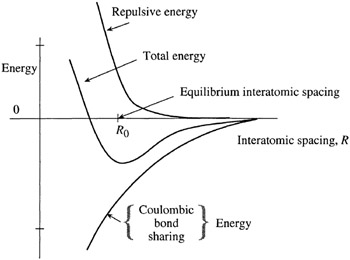
In Chapter 1 we have discussed how atoms are arranged in a crystalline material. The reason a particular crystal structure is chosen by a material has to do with the minimum energy of the system. As atoms are brought together to form a crystal, there is an attractive potential that tends to bring the atoms closer and a repulsive potential which tends to keep them apart. As a result the overall energy-configuration profile for the system has a schematic form, shown in Fig. D.1. The total energy of the system is minimum when the atomic spacing becomes R 0 as shown in the figure.


Figure D.1: General form of the binding energy versus atomic distance of a crystal. In the case of most semiconductors, the long-range attraction is due to either electrostatic interactions of the ions or the bond-sharing energy of the covalent bond.

In general we can expand the crystal binding energy around the point R 0 as follows

(D.1)

The second term is zero since R 0 is the equilibrium interatomic...

UNLIMITED FREE
ACCESS
TO THE WORLD'S BEST IDEAS

SUBMIT
Already a GlobalSpec user? Log in.

This is embarrasing...

An error occurred while processing the form. Please try again in a few minutes.

Customize Your GlobalSpec Experience

Category: Superconductors and Superconducting Materials
Finish!
Privacy Policy

This is embarrasing...

An error occurred while processing the form. Please try again in a few minutes.