Soil Testing Manual: Procedures, Classification Data, and Sampling Practices
There can be many factors that affect the shear strength of cohesive soils, such as the following:
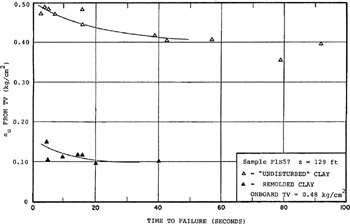
Sample disturbance. As previously discussed in Sec. 2.3, a soil sample cannot be taken from the ground and be in a perfectly undisturbed state. Disturbance causes a decrease in effective stress, a reduction in the interparticle bonds, and a rearrangement of the soil particles. Sample disturbance can cause the greatest reduction in shear strength of any other factor. As an example of the effects of sample disturbance, Fig. 9.29 shows the undrained shear strength s u of "undisturbed" and remolded Orinoco clay and indicates about a 75 percent reduction in the undrained shear strength (Ladd et al. 1980, Day 1980).
Figure 9.29: Effects of sample disturbance and strain rate on the undrained shear strength of Orinoco clay. ( From Day 1980.)
For clays having a high sensitivity, such as quick clays, disturbance can severely affect the shear strength. In instances of severe disturbance, quick clays can be disturbed to such an extent that they even become liquid (essentially no shear strength).
Strain rate. The faster a soil specimen is sheared (i.e., a fast strain rate), the higher the value of the undrained shear strength s u. For the unconfined compression test, laboratory miniature vane, and the Torvane test, the strain rate is very fast with failure occurring in only a few minutes or less. In Fig. 9.29, Torvane tests were performed on the...