Survivability and Traffic Grooming in WDM Optical Networks
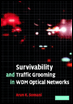
Providing detailed coverage of key issues in modern optical networks, this highly useful book provides a framework for dealing with survivability and traffic grooming in wide-area networks.
 TABLE OF CONTENTS
 Technological advances in semiconductor products have essentially been the primary driver for the growth of networking that led to improvements and simplification in the long-distance communication infrastructure in the twentieth century. Two major networks of networks, the public switched telephone network (PSTN) and the Internet and Internet II, exist today. The PSTN, a low-delay, fixed-bandwidth network of networks based on the circuit switching principle, provides a very high quality of service (QoS) for large-scale, advanced voice services. The Internet provides very fleexible data services such as e-mail and access to the World Wide Web. Packet-switched internet protocol (IP) networks are replacing the electronic-switched, connection-oriented networks of the past century. For example, the Internet is primarily based on packet switching. It is a variable-delay, variable-bandwidth network that provides no guarantee on the quality of service in its initial phase. However, the Internet traffic volume has grown considerably over the last decade. Data traffic now exceeds voice traffic. Various methods have evolved to provide high levels of QoS on packet networks particularly for voice and other real-time services. Further advances in the area of telecommunications over the last half a century have enabled the communication networks to see the light. Over the 1980s and 1990s, research into optical fibers and their applications in networking revolutionized the communications industry. Current telecommunication transmission lines employ light signals to carry data over guided channels, called optical fibers. The transmission of signals that travel at the speed of light is not new...